
Environmental Constitutionalism: A Revolutionary Framework for Sustainable Governance
- ILS Hariyali
- Dec 30, 2024
- 5 min read
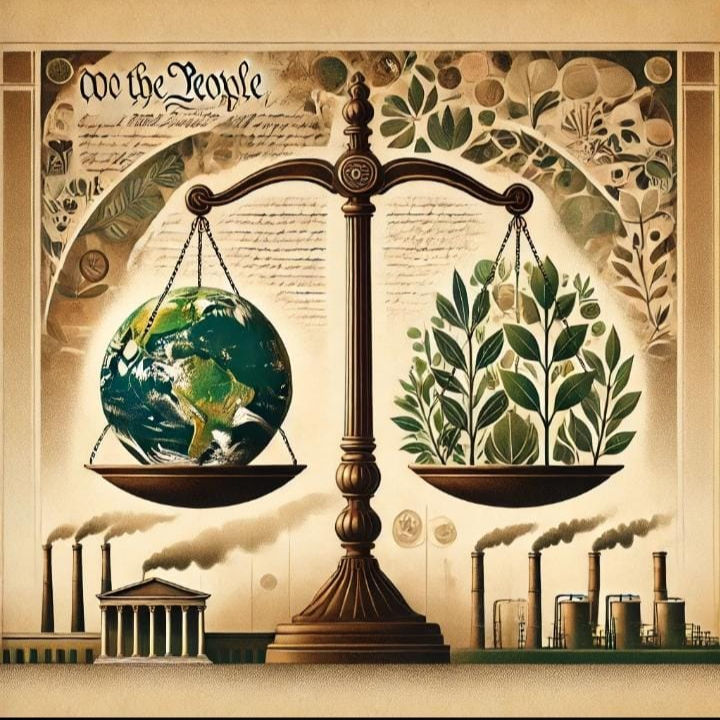
There is evidence in the Vedas, Upanishads and Smritis that man has been living in complete harmony with nature since ancient times. Hindus believe that God is omnipresent and is present in all elements of nature.[1] The environment and its problems were held in high regards earlier and even referred to as Mother Earth, but environmental obligations didn’t get any substantial place on the constitutional agenda during drafting. The makers of the constitution ignored this obligation of protecting and preserving nature.[2] The modern age has presented the environment with previously unheard-of difficulties due to the rapidity of industrialization, urbanization, and growth in population. Ecological systems are under more stress as a result of societies' focus on economic growth, endangering public health, biodiversity, and natural resources. As a result, the idea of a "environmental constitution" has surfaced as a body of legislation that makes sustainability and environmental preservation central to governance.
What is Environmental Constitutionalism?
Environmental constitutionalism deals with the impact of environmental quality and the environmental rights of citizens through constitutional provisions[3]. Concerns about environmental rights protection and how constitutions around the world use a rights-based system to provide for the environment are closely related to environmental constitutionalism.[4] About ninety-two constitutions explicitly recognise the right to a quality or healthy environment. Some ninety-seven constitutions include reciprocal duties on the state and fifty-six constitutions recognize the responsibility of the citizens to protect the environment.[5] Douglas Kysar, defined environmental constitutionalism as “the constitutionalisation of environmental protection, and elsewhere as the constitutionalis[ation] of environmental law, which, he admits, remains largely a symbolic work as constitutional provisions are usually weak in enforcement and the most important factor for environmental protection is implementation.[6] The empirical-evaluative analysis of environmental constitutionalism leads to the more optimistic conclusion that, although no country has yet attained the ultimate objective of sustainable ecology, constitutional environmental protection can be a potent and potentially transformative step toward that difficult goal. Environmental constitutionalism can also be seen as a process of transformation that provides constitutional environmental protection.[7]
Key Constitutional provisions introduced:
The Stockholm convention was held in Sweden in 1972 with the slogan of “Only One Earth”. On this One Earth, environmental integrity, peace and development are collectively interdependent and mutually reinforcing goals.[8] It is considered as Magna Carta of environment protection and sustainable development. In order to specifically include environmental protection provisions within the guiding principles of state policy and fundamental duties, the 42nd amendment was introduced as a result of this conference. This amendment added Article 48 A which requires the citizens to “To protect and improve the environment and to safeguard forests and wildlife”[9] Although the guiding principles of state policy are not legally binding, they are acknowledged as essential moral standards and ideals in the nation's governance to protect social and economic liberties. Because of long-standing cultural, social, and legal experiences and practices, environmental constitutionalism acknowledges that "environmental care," as represented through moral and ethical principles, can contribute to the environmental protection required for human flourishing.
Article 51 was also added by the 42nd amendment. Article 51-A (g) states, that “It shall be duty of every citizen of India to protect and improve the natural environment including forests, lakes, rivers and wild life and to have compassion for living creatures.”[10] This indicates a change in acknowledging individual responsibilities in environmental governance. A pluralistic society's common moral and ethical duties can be seen by the concept of "environmental care," which is established by Articles 48 A and 51 A (g) jointly. The Supreme Court has regarded Article 48A and 51 A (g) the unenforceable constitutional commitments as supplementary and complimentary to the enforceable fundamental rights, especially Article 21 in Intellectuals Forum, Tirupathi v. State of AP[11], in order to reinforce them.[12] The three-pronged environmental protections found in the Indian constitution are probably unmatched in the world.
Article 21 of the Indian Constitution guarantees the fundamental right to protection of life and personal liberty.[13] The court held in Municipal Corporation of Greater Mumbai v. Kohinoor CTNL Infrastructure that the right to a clean and healthy environment falls within the purview of Article 21. Living in a clean, safe, and dignified environment is a fundamental aspect of the right to life.[14] Thus, in a flurry of court rulings, the Constitution's Articles 21, 48 A, and 51 A (g)42 guarantee the right to life, liberty, and pollution-free air and water. Both the state and citizens have a responsibility to take suitable measures to enhance, preserve, and promote the natural and man-made environments.
A landmark case in environmental law, M.C. Mehta vs. Union of India,[15] emerged soon after the devastating Bhopal gas accident in 1984, which increased public concern over industrial safety which caused death of one person and numerous others were hospitalized as a result of the oleum gas leak from the Shriram factory on December 4 and 6, 1985. Under Article 32 of the Indian Constitution, environmental lawyer and activist M.C. Mehta, also known as the "Green Avenger," filed a writ suit to close the Shriram factory because of its dangerous operations in a heavily populated area[16]. The right to equality (Article 14), the right to life (Article 21), and the right to freedom of trade and commerce (Article 19(I)(g)) have all been referenced and used as the foundation for judicial decisions in environmental cases. Political rights are the first generation of rights, followed by social and economic rights in the second generation and environmental rights in the third generation.[17]
The higher judiciary's response to the state's inaction or state agencies' failure to carry out their statutory obligations that jeopardize or degrade people's quality of life as provided by the constitution is known as an environmental PIL. As a result, impacted residents, NGOs, and environmentalists have turned to the courts—especially the higher judiciary—for redress. In this regard, PIL is embodied by environmental constitutionalism as a revolutionary strategy to give victims of environmental degradation access to justice.[18]
Conclusion:
At a time when environmental deterioration and rapid development have come together, adopting a rights-based, constitutionally required strategy is crucial. Environmental constitutionalism embodies the idea of "Only One Earth" in administration and practice by encouraging a culture of shared responsibility between the state and its people, protecting the environment while simultaneously guaranteeing a healthy and dignified existence for all.
By,
Anvita Kadam,
III BA LLB
ILS Law College, Pune.
[1] Bhaskar Kumar Chakravarty, Environmentalism: Indian Constitution and Judiciary, Journal of the Indian Law Institute, Vol. 48, No. 1 (2006), pg.99 last seen on 17/12/24, available at https://www.jstor.org/stable/43952020.
[2] Ibid 1
[3] Blake Hudson. “Structural Environmental Constitutionalism.”Widener Law Review (2015) : 201-216. Hein Online.
[4] Louis J. Kotze. “The Conceptual Contours of Environmental Constitutionalism.” Widener Law Review (2015) : 187-200. HeinOnline. Web.
[5] Klauss BOSSELMANN, Global Environmental Constitutionalism: Mapping the Terrain, Widener Law Review, 2015, pp. 171-185, p. 173.
[6] Ibid 5, page 188
[7] Ibid 4 , page 188
[8] David Michel, One Earth, one security space: from the 1972 Stockholm Conference to Stockholm+50 and beyond, available at https://www.sei.org/perspectives/one-earth-one-security-space/#:~:text=The%201972%20Stockholm%20Conference%20crystallized,interdependent%20and%20mutually%20reinforcing%20goals. last seen on 17/12/24
[9] Article 48A , Directive principles of state policy
[10] Article 51 A(g), of the Constitution of India
[11] Intellectuals Forum, Tirupathi v. State of AP, 2 (2006) 3 SCC 549
[12] Environmental Constitutionalism in India: Judicial Recognition and Application, Professor Gitanjali Nain Gill, https://nrl.northumbria.ac.uk/id/eprint/33806/1/Gill%20-%20Environmental%20Constitutionalism%20in%20India%20AAM.pdf.
[13] Article 21 of the Constitution of India
[14] Municipal Corporation of Greater Mumbai v. Kohinoor CTNL Infrastructure (2014) 4 SCC 538.
[15] M.C. Mehta vs. Union of India, (2009) 6 SCC 142.
[16] Case Comment: MC Mehta Vs Union of India, 1987, Academike, https://www.lawctopus.com/academike/case-comment-mc-mehta-vs-union-of-india-1987/. Last seen on 20/12/24.
[17] Shobana Ramasubramanyam v. Chennai Metropolitan Development Authority, AIR 2002 Mad 125.
[18] Environmental Constitutionalism in India: Judicial Recognition and Application, Professor Gitanjali Nain Gill, https://nrl.northumbria.ac.uk/id/eprint/33806/1/Gill%20-%20Environmental%20Constitutionalism%20in%20India%20AAM.pdf.


Comments